Ph: +61 415 854 179

Photography techniques explained, camera reviews, photo technical stuff

A really BIG Photographic Canvas print!

March 8th, 2011
4m canvas print laid out at Monk Art Photography Gallery
Freshly arrived…

I have mentioned this 4m Photographic canvas image a few times in previous posts, but i wanted it to be up on the wall before putting it on the blog,  it seemed only fair that the client should see it first, especially since it has been so long in the making.

Nigel Stretching the 4m canvas onto the custom made frame
Into it… a slightly dreaded job

I was pretty excited when i got an order for a 4m image, a vertical one at that, i’d never printed anything so big and i was very keen to try it.  I was confident the image would would print up well, it was shot on a large format panoramic camera, a Fuji GX 617 on a 6 x 17 cm piece of transparency film (Fuji Velvia), like most of the images in my gallery.  It was then scanned at 3200 dpi and 16 bit on an Imacon 848 scanner to over 900Mb, so there was tons of fine detail and information to work with.  The finished layered file came in at 2.9Gb… Thats a lot of hard drive space for one image.

My printer is an Epson 9900, which is 111cm wide (44″), so i can print an image of this format (3:1 ratio) to about 3m long… not big enough for this one.  So i called my friend Paul Parin from Studio Red Dust, who has an Epson 11880, the big brother to my printer.  The Epson 11880 can print to 152cm wide (60″) and with the right software and the right person driving it, for as long an image as you could want.  Paul is very proffesional and really knows how to drive his printer, so the results were spectacular.

The 4m canvas photographic image by Adam Monk takes shape
Thats pretty big…

The timber for the stretcher frame had to be custom made, and Nigel from Bitches Brew Picture Framers, who shares the gallery space with me, had  a few sleepless nights worrying about stretching this monster before clearing a space on the gallery floor and tackling the job.

Hanging the 4m canvas image in its final spot
Rob carefully measuring

My delivery van has a maximum  length of 3m it can  fit in the cargo area, so last Saturday i hired a truck and delivered this 4m long image to its new home, where Rob, from Master Art Display and myself put it into its final location.

The 4m vertical photographic image on the wall at last
The final result.

Each of these images of the stretching and hanging of the 4m photographic canvas print were taken on the Canon 5D Mk II with the 17mm f4L tilt shift lens to keep the perspective and gain some unusual focal planes (click on the images for a closer look).  The last image was not taken by me, since i am in the shot, but by Rob the Picture hanging expert, who also happens to be pretty handy with a camera.

A Garota de Ipanema on the wall

March 7th, 2011

2.5m print of A Garota de Ipanema-The Girl from Ipanema, on the wall

A Garota de Ipanema in its new home

Just a quick one to show the final result of the 2.5m canvas print of “A Garota de Ipanema” (the Girl from Ipanema) from previous posts.  I rented a truck and delivered this image and the 4m vertical (next post) to their final destinations on Saturday, and Rob, from Master Art Displays installed them both.

Click HERE>> To read the story of how this photograph was taken.

Epson 9900 printer in action

February 24th, 2011

Today i printed a 2.5m print of one of the Hasselblad XPan images that featured in a previous post, A Garota de Ipanema-The Girl From Ipanema.  It was quite a stressful event, as 2.5m of image allows a lot of room for things to go wrong.  Nothing went wrong, it looks awesome.

Epson 9900 large format printer 1

The Epson 9900, a formidable beast

I have an Epson 9900 printer, a formidable beast indeed, it can print 110cm, or 44 inches wide and this 2.5m print is the biggest image i’ve ever printed in one go.  The 4m canvas previously mentioned was printed by Paul Parin, from Studio Red Dust on a bigger printer, an Epson 11880, which is 152cm, or 60 inches wide.  There will be a blog post about that 4m image once it is installed in its proper place.

As you look through these photos (click to enlarge) you can see the progress of the print.  Its difficult to imagine scale from a small photo, but just remember that the canvas this image is being printed on is 1.1m wide…

Epson 9900 large format Printer 2

Half way there

I’ve printed many 2.2m images before, there are usually 2 or 3 hanging in the gallery at any one time, and 2.5m is only 30cm bigger after all… so whats the big deal?  Well, the software driver of the Epson 9900, as with all past models, is supposed to be limited to a total print length of 2.28m, unless you are using a RIP (Raster Image Processing), which is an expensive bit of additional software.  If you try printing an image longer than this through Photoshop, which uses the Epson printer driver software to run the printer, you get some bizarre and annoying results, including wasting a lot of canvas.

I dont have a RIP, at a starting cost of $2000 for a reasonable one that would do the job i never saw the need for it when the vast majority of my printing is well below the 2.28m limit.  So how did i print this image?

Epson 9900 large format printer 3

Three quarters of the way there…

Well, i rang Paul from Studio Red Dust, who also doesn’t use a RIP, and he told me a little trick he’s discovered for getting around the limit. Save the image as a high resolution printing pdf from Photoshop, then print it out of Adobe Acrobat…  It works perfectly.  It shouldn’t, Acrobat should still be using the Epson driver software to run the printer, but it works anyway.  Go figure…

Epson 9900 large format printer 4

Ah, Safe and sound.

Phase One at Rottnest

February 7th, 2011

I was over at Rottnest the other day and i had borrowed the medium format Phase One camera and P30+ digital back.  This was the 30.5 megapixel version, the P30+ not the mega huge 60.5 mega pixel P65, but none the less, its an impressive file size and it works just the same.

The first thing i noticed was how good it feels in the hand, its well balanced and weighty enough to feel substantial but not too heavy, with the aperture and shutter dials in just the right places for the thumb and forefinger.  The one i tested had the 80mm lens on it, which is the 35mm equivalent of about a 50mm lens, rather than the wide angle lenses i prefer, but a very nice lens none the less. (click here to read about the Depth of Field dilemma of medium format)

Rottnest Island sand ripples, Rottnest Island Western Australia

Rottnest Island Sandscape 1

The auto-focus is a bit agricultural compared to DSLR like the Canon 5D Mk II, but then medium format has always been bigger and slower and the Phase One focuses where you point it so it does the job required.  There is solid thunk when you press the shutter, so you’ll never be in any doubt you’ve taken a picture and it does take a while to write to the card before you can take a second shot, so its not ideal for sports photography, but then why would you use a camera like this for sport photography? Read the rest of this entry »

Depth of Field explained

February 5th, 2011

DOF

Depth of Field (DOF) confuses many people, especially in relation to medium format cameras Vs 35mm format cameras.  Why do lenses that give essentially the same view on their respective format, say and 80mm on medium format and a 50mm on 35mm format,  exhibit dramatically different DOF, even at the same f-stop?

Firstly, what is Depth of Field?

The focal point of a lens is in fact a focal plane, a flat 2 dimensional field out in front of the lens where everything is actually and truly sharp (assuming a good quality lens), that is, a point in our subject focuses to a point on our film or sensor.  This plane shifts forwards and backwards as we move the focusing ring of the lens and is usually parallel with the film or sensor plane of the camera.  The DOF is the range fore and aft of this focal plane that appears to be sharp in our final image.  It is not actually sharp, in the strict definition of the word, but each point (from our subject) forms a circle of confusion on our sensor that is sufficiently small as to appear as a point in the final image, thus it looks sharp. This Depth of Field, also known as the range of acceptable sharpness,  is effected by 5 primary factors…

  1. The focal length of the lens:  The shorter the  focal length, (wide angle lenses), the greater the inherent DOF at all relative apertures.
  2. The aperture used:  The smaller the aperture, the smaller the Circles of Confusion will be.  Rendering more of the image with the appearance of being sharp… up to a point.  Beyond that point (this will differ for each lens), diffraction through the lens will start to have a significant effect, this will soften the overall focus regardless of the DOF increase.  Once the aperture declines below a point where the DOF blur is smaller than the diffraction blur, the image will begin to increase in sharpness again.  So some lenses with a big aperture range  can actually become sharper  at the extreme end of their  scale (such as f45 or f64).  Many large format lenses, particularly those made for landscape photography, are actually optimised for maximum f-stop use, and can be rather soft when used with less than this extreme aperture.
  3. The subject distance:  The closer the subject is to the lens the less is the apparent DOF, especially when taken to extremes in macro photography, when DOF can be measured in fractions of a millimetre.
  4. The format of the camera used:  The larger the format of sensor or film used the higher its resolving power, and the greater the level of detail it can record.  To create a print of the same size the medium format image requires far less enlargement, thus the larger the Circle of Confusion size can be and still appear sharp (in the same size final print).  Thus, for the same focal length, at the same subject distance, the same f stop, the greater the apparent DOF in the final print for the medium format sensor over the smaller format for the same size print.
  5. The enlargement of the image:  The more an image is enlarged the less DOF it will exhibit.  The circles of confusion that appear sharp in smaller prints (or screen enlargements) will become more obviously soft, both forward and behind the actual focal plane, effectively narrowing the DOF.

Depth of Field and Medium format cameras

If the same image is taken with two different format cameras, say a 35mm camera and a medium format camera, at the same subject distance, the same f-stop, with the same focal length lens  and the resulting images are printed  to the same size, the medium format image will have greater apparent DOF.

An 80mm lens is an 80mm lens  whichever camera its on, the focal length at infinity is 80mm and its DOF is a constant factor of the f-stop used.  What changes is how much of the image projection is included in the frame,  the angle of view.  A 35mm camera has a film area (or sensor) of 36mm x 24mm, whereas a medium format camera has a much larger area of film or sensor, usually between 60mm x 45mm to 60mm x 70mm. This is a considerably bigger area so the sensor “sees” a much wider view of  the image the lens is projecting, which changes the perspective to a wider field of view.

So effectively, the same focal length lens can be a telephoto with one format, but a wide angle in another, as illustrated in the example below.  This is an image shot on a 6×17 format camera with a 105mm lens.  It gives a very wide field of view, and a 105mm is considered a wide angle lens on this format camera.

The cut out outlined in black is a 35mm film format size.  What you would get if you shot the same scene, from exactly the same place with a 105mm lens (with the same exposure settings) on a 35mm camera, and you can clearly see it is a medium telephoto field of view.  Obviously both will have the same DOF.  This is a real example, it’s actually what you would get if you stood in the same place with the two cameras and took the same shot on both with the 105mm lens… Or, you could simply take it on the 6×17 camera, develop the film, and take a pair of scissors and cut out a 24x36mm rectangle, and get exactly the same result.

Fortescue fallsin Karijini NP used to show the differences between large and small format cameras

A 35mm perspective size cutout, in a shot taken with a 105mm lens on a 6x17cm large format camera

 Large Depth of Field

What seems to be the difficult part for people to understand here is the field of view, and how the DOF relates to it… in short, it doesn’t relate at all.  Although a 50mm lens on a 35mm format camera and an 80mm lens on a Medium format camera give you a similar field of view, they will not give you the same DOF for a given aperture.   It’s an easy mistake to make, to assume because your angle of view looks the same, your DOF will be the same too… But DOF is dependent on Focal length, not field of view, so the 80 mm lens on the medium format in fact has the same DOF as an 80mm lens on 35mm format (for the same aperture).

The Way it was

Back in the good old days (I’m showing my age here) when photographers shot on a variety of formats it was no problem.  We all understood that how wide a lens’s field of view is, is determined by the format of the camera its used on.  We also understood that DOF was not determined by this field of view, but by the actual focal length of the lens (and the f stop used).  So you would just shift gears with each change in camera format, and understand that, for example, a 90mm lens on a 5″x4″ (12 x 10cm) camera was a really wide lens, whereas on a 6x6cm medium format it was a slight telephoto, but the DOF at the same aperture would be the same (excluding the enlargement factor).

The new Issue

Since the ascendence of the 35mm film or sensor format they have become the benchmark and since most people never use other formats they never see the possible variance.  Thus a normal lens is 50mm, a 100mm is a telephoto and a 35mm is a wide angle… all the time.  While everyone is shooting the same 35mm film format that is fine, but then the camera companies started coming up with APS c sensors, micro 4/3 sensors and all the other tiny sensors in smaller point and shoot cameras and phones.

My Fuji point and shoot camera has a zoom lens that they have very kindly converted to 35mm speak as 28-112mm, which is about what it looks like on the screen at the back.  The 28mm end of the scale looks nice and wide and pretty much how you would expect a 28mm lens field of view to look, and the 112mm end of the zoom gets up nice and close like a small zoom should…

But then I read the fine print in the manual and the lens is in fact a 7.1-28.4mm zoom… so what?  Well, what it means is that at full zoom, at what looks like 112mm (in 35mm speak), I get the DOF of a 28mm lens, which has just about everything looking sharp, even with the aperture wide open, which is almost never what you want with a telephoto lens.  So you see now we have the opposite problem to previously, now people are getting far more DOF than they expect and our images are looking flat…

Perfect Printing Photography Workshop part 2

November 1st, 2010

Phew, what a weekend!

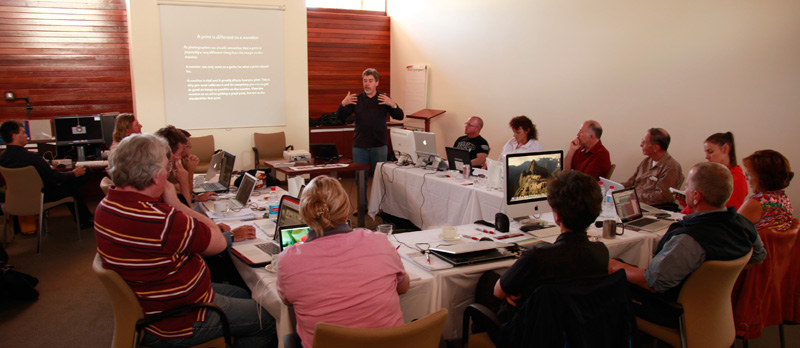
The Perfect Printing photography workshop concluded last night, after 2 days of intensive hands on digital printing and workflow down in lovely Margaret River.

Greg making a point

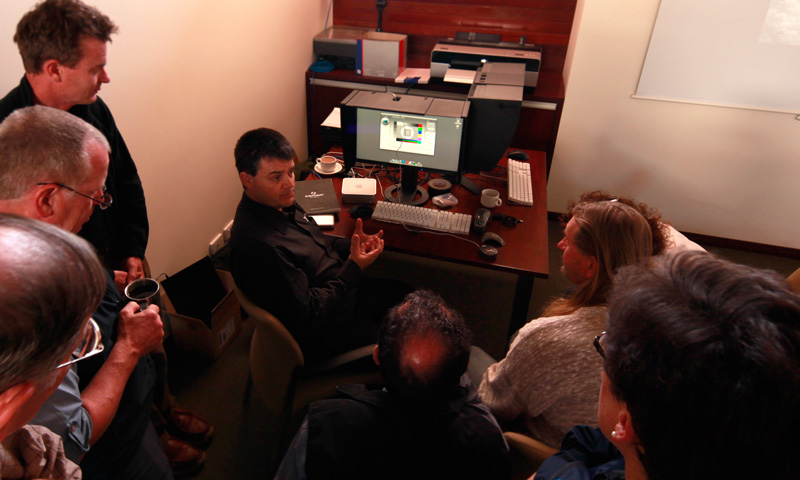
I would like to thank all the participants for making the course such a success, and an extra special thankyou to Trevor from Team Digital, who came down for the Saturday with a whole car load of toys, including Eizo Screens, screen calibrators, a awesome Epson 3880 printer, a whole selection of new Cancon paper and canvas to try, a Gigapan and the Phase One.  He certainly worked hard for his lunch that day with a whole room full of  enthusiastic participants firing hard questions his way.

Screen Profiling with Trevor

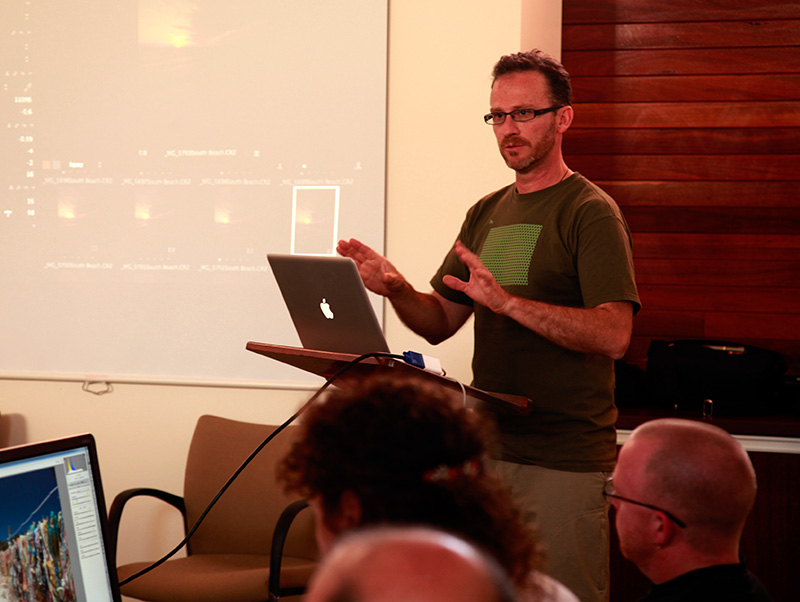
There was a wide range of experience levels within the course, and Greg and I tried to ensure we aimed our talks so everybody got something out of them. We then modified the planned presentations according to the discussions from the day before and the most common questions being asked, there was even a couple of impromptu info sessions to ensure everyone understood the concepts behind the topics, and a couple of bonus discussions on Photoshop tweaks and tricks.

Me talking with my hands

I do hope everyone enjoyed themselves and found this 3 day printing workshop fulfilling and useful,  any feedback from course participants would be most welcome right here on the blog, so dont be shy!

Perfect Printing Photography Workshop Part 1

October 27th, 2010

The first day of the Perfect Printing photography workshop for 2010 was last Sunday at the Royal Freshwater Bay Yacht Club,  it was the most concentrated day of the three, packed with explanations and printing terminology definitions.  There were a few confused looks during the talks, especially during my presentations on colour management theory (what the %#$@ is a Rendering Intent?), but most of those had changed to comprehension by the end.

The test of all of this will come  next weekend at Margaret River when the second component will be run;  it will be more relaxed and more fun with everyone working on their own images and making prints on the Epson 3880 printer, supplied by Team Digital.  We will soon find out who has done their colour management homework…

Wedding Photography and Auto Functions

October 12th, 2010

Yesterday i shot a wedding for the first time in about 7 years. It was the 10/10/10 and apparently that is a great day for a wedding, because despite the terrible weather, there were al least another 4 weddings taking place within a stones throw of the one i was photographing.

I’ve been trying to be a little creative with ways to get out from behind the gallery counter more and back behind the camera, where i love to be, so when a friend asked me if i might shoot his daughters wedding, not really expecting me to say yes… (him understanding my love of empty quiet places and general dislike of crowds.) i surprised both of us when i said, sure, why not?  Well, i had just bought the Canon 5D Mk II and was having fun taking pictures of anything and everything so it seemed like providence. Read the rest of this entry »

A question of Pixels

October 1st, 2010

All  the images on my site are shot on large format film, except one… can you pick it?   I have many thousands of negatives of all formats from 5″x4″ to 35mm in folders all over the place… so much for organised security!

I’ve had a lot of fun with film, and used more than my fair share of it over the years.  Time i moved on, so,  about 8 months ago  i bought my first real digital camera, a Canon 5D Mk II  and  i am loving it.  I recently took it with me to Greece and i just had a ball, shooting HDR images (manually blended with layers) and stitched Panos with this awesome  pano head from Really Right Stuff that i picked up a while back.  This camera is not just my first real digital, its my first camera with auto focus!  I’ve been sitting on the fence for quite a while it seems.

The last 35mm gear i had was a Leica RE with a whole bag of beautiful prime lenses, all manual focus and full manual exposure.  I think the camera had some auto exposure functions on it, but i never used them, so i have no idea if they worked or not.  I just sold this camera recently, it’s helping pay for the new setup.

I remember 12 years ago when i worked for Fremantle Black & White (Black & White lab here in Freo), and using one of the first serious professional digital cameras in the studio, it was about 1.5 mega pixels and hugely expensive.  It had a viewing screen the size of a postage stamp and was awfully slow, but even then it was clearly the way forward, though it had a long way to go.

South Beach sunset in Fremantle Western Australia

Check out the depth of field

A couple of days ago i picked up the latest addition for the Canon 5D Mk II kit, a 17mm f4L Tilt Shift lens. its a bit more like what i’m used to, being a prime lens with manual focus.  Although it’s really designed for architectural style work, the tilt and shift capabilities make it ideal for landscape due to the almost infinite depth of field possible.  I took it down to South Beach yesterday after work and had a bit of a play around, takes a bit of getting used to, but i think its going to be awesome for stitching pano images.

I think it’ll still be a while before i replace the 6 x 17 film camera, but not because i think it’s better than digital, rather, i can’t yet afford the camera that can replace it.  Anybody want to lend me $50,000?

Sunset at South Beach in Fremantle Western Australia

Both these images shot at f5.6

Photographic Workshops and Tours – the pains of Public Speaking

September 20th, 2010

I spent the day today, between talking to clients, working on my presentations for the next photographic workshop, Perfect Printing.  Today i was writing up the notes for the colour management part of the course, and i found myself just writing and writing and writing… i kept thinking, this is way too much,  this talk is only supposed to last an hour or so and i’m going to go on all day!

Its amazing how teaching something to others can really clarify it in your own mind, i mean, colour management, the words that can strike fear into the hearts of the  bravest photographer, is something that i learned by osmosis over many years of trial and error.  Reading a bit here a bit there, getting crazy results and trying to figure out why, talking to somebody in passing and picking up a tip or two, reading a bit more.  Now i’m trying to collate all these years of experiences and condense them down into a palatable not too boring talk of an hour or so… because this is, after all, just one component of the 3 day photographic workshop about printing.

It seems the art is not so much about what to put in, but what to leave out, thats what i mean by clarifying, its forcing me to organise my thoughts on something that i’ve never tried to explain to anyone before and really glean out the important bits.  Its actually a fantastic process, and one i am enjoying very much.

This is only my second full photographic workshop (teaching, that is), so it’s still a very new experience for me and  has surprised me just how much fun it can be.  Its taken me many years to feel that i have reached a standard high enough to be able to teach anything to others, and the great thing is that it really is a two way process,  i am learning about as much again in return, both in the preparation, and in the presentation.

It is said that its good to face your fears.  One of my fears has always been public speaking, i don’t shoot wilderness landscapes for nothing you know, no crowds to direct out there!  At the last workshop just before my first presentation i felt like i was going to die and running away seemed like an excellent alternative option.  Just me in front of 30 odd people… it felt like 30,000.  Suddenly it all felt very real, and i was $hitting myself!

Well, i got the first word out, then the second and the the third, and i didn’t die.  by the time i got to the third or fourth sentence i felt my heart slow down a little and i could almost breath again… Then i began enjoying myself.  People actually laughed at my jokes (They were jokes about me, always the best topic for jokes i reckon, can’t hurt anybodies feelings that way), and they seemed to be interested in what i had to say!  It was a great experience and my one hour talk went on for two and a half hours.

I cant really say I’m totally over my fear of public speaking, i reckon i’ll still get the urge to run away. Plus  now i’ve got the extra challenge of  trying to make Colour Management sound interesting and exotic!  Got to think up some new jokes… lots of them…

Privacy Policy

Monk Art Photography is fully committed to protecting the personal privacy of visitors to this website. We promise to keep your personal information secure and use it for internal purposes only. We will never pass on your details to third parties and will only contact you regarding information you have asked for.

Should you feel we have not adhered to these principles, please feel free to contact us any time here...

Terms of Use

Monk Art Photography reserves the right to change specifications, prices and availability of images without notice. Any price variation will not affect existing orders.

Images and website content ©Adam Monk 2026. All rights reserved. Unauthorized use of images, copying or any other derivative works are prohibited without the express written consent of Adam Monk.

Shipping & Delivery Policy

Orders must be paid for in full before shipping.

All prices stated include worldwide postage, packaging and full insurance. Images are packed rolled in reinforced postage tubes and sent via registered post or courier. All images are unstretched and unframed. In the rare event that any damage should occur in transit, you should advise us here at Monk Art Photography immediately and we will have a replacement shipped to you as soon as the damaged item is returned.

Delivery of your order is within 4-6 weeks from the date of purchase.

Cancellations of orders cannot be accepted once your images have been printed and shipped.

When placing an order please ensure your shipping address is correct. Orders returned due to an incorrect address will incur an additional re-shipping charge.

Insurance

All orders are fully insured door to door.

Returns and Refunds

We do not normally accept returns or offer refunds, but should you have any concerns please contact us and we will do our utmost to resolve them.